Showing posts with label eTwinning projects 2020_2021. Show all posts

Saturday, 10 July 2021

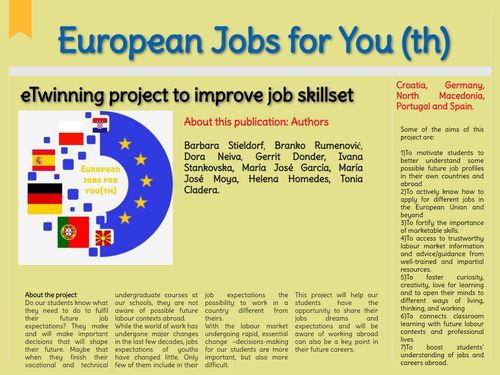
European Jobs for You(th)


About the project

Do our students know what they need to do to fulfil their future job expectations? They make and will make important decisions that will shape their future. Maybe that when they finish their vocational and technical undergraduate courses at our schools, they are not aware of possible future labour contexts abroad.
While the world of work has undergone major changes in the last few decades, jobs expectations of youths have changed little. Only few of them include in their job expectations the possibility to work in a country different from theirs.
With the labour market undergoing rapid, essential change –decisions-making for our students are more important, but also more difficult.
This project will help our students have the opportunity to share their jobs dreams and expectations and will be aware of working abroad can also be a key point in their future careers.

AIMS

Effective job possibilities guidance encourages students to reflect on where they will have chance to work and what kind of professional, they want to become and to think critically about the relationships between their educational choices and future jobs in their own countries and abroad. Some of the aims of this project are: 

  1. To motivate students to better understand some possible future job profiles in their own countries and abroad, 
  2. To actively know how to apply for different jobs in the European Union and beyond,
  3. To fortify the importance of marketable skills.
  4. To access to trustworthy labour market information and advice/guidance from well-trained and impartial resources.
  5. To foster curiosity, creativity, love for learning and to open their minds to different ways of living, thinking, and working.
  6. To connects classroom learning with future labour contexts and professional lives.
  7. To boost students’ understanding of jobs and careers abroad.


WORK PROCESS

Our initial timeline could be modified according to the project path but approximately:
Up to September: Teachers pre-planning.
  • September: welcome to eTwinning, code of conduct, commitment to netiquette rules, Twinspace, who is who, where we live, this is our school and international teams. Communication in forums.
  • October: Job profile knowledge brainstorming. What kind of jobs could our students develop as soon as they finish their vocational studies? Student will create digital products to share possible job profiles in all countries of the project partners.
  • November-December: Students will explore on the internet some jobs offers and vacancies related to their education and will prepare an application form according to the offer.
  • January-February: How could our student apply for jobs abroad? They will share their CV created with a variety of IT tools in order to improve their digital knowledge and marketable skills with the ideas and contributions from all eTwinners.

EXPECTED RESULTS

  • Marketable, digital, social and communication skills improvement.
  • International chances of work awareness in motion. 
  • International Twinspace with digital products to foster our students expectations to work abroad.
  • An international e-Book of European jobs and a Blog to share and disseminate our students’ skillset improvement.
  • Virtual exhibition of posters and any other digital products created in the project.


Friday, 30 October 2020

eTwinningreen4u

 eTwinningreen4u


About the project

Climate change crisis is a complex environmental, scientific, individual, and social situation that earth planet faces at the same time that its development and technification. 

Students are involved on news related to current threads and future catastrophes in which will be experienced if humanity keeps on emitting pollutant gasses that retain heat under atmosphere or any other harmful actions that cause environmental damage. 

But are students as citizens a cause of or may also be solution to climate change?

Scientifically dealing with climate crisis presents a great challenge for students and offers teachers from any subjects a perfect opportunity to foster and nurture students’ full potential through different learning approaches. This project will help to mitigate future problems with their current researches, making meaningful their learning process and enable them to take ownership over their own learning and results.

Aims

  1. To fortify the importance of critical thinking and enhance problem-solving. 
  2. To foster curiosity, creativity, love for learning and scientific method applying.
     
  3. To motivate students to actively take part in environmentally friendly actions and see their positive impact on real life.  
  4. To open their minds to different ways of living and thinking
     
  5. To build social, emotional, scientific, and meaningful skills while improving their digital competence.

This project is also aimed at emphasizing our student’s role in their learning process, giving them the autonomy to explore, ask questions and share ideas. 

Teachers will facilitate students to celebrate the international climate change summit in February on the Twinspace as a scientific congress to share their researches and eco-actions in motion.

Work process

Starting with a driving question, students will research causes and consequences of climate change and how it impacts on health, economy, and any other field of education (from any subject is possible to address climate change at school). Students will calculate their Carbon Footprint, be aware of how their lifestyle influences the environment and will propose actions, tips, change of attitudes, ways of acting that offset their Carbon Footprint on Earth.


Our initial timeline could be modified according to the project path but approximately: 

  • Up to September: Teachers pre-planning, September: welcome to eTwinning.
  • October: Background knowledge brainstorming. Climate change and CO2 Footprint calculation. Climate change Data sets.
  • November-December: Addressing climate change in our lessons. 
  • January-February: What can we do to become green? Simply, short, clear, and visual solutions and actions to help students and society become greener. 
  • International climate change summit on Twinspace 2021

Expected results

  1. Inquiry, digital, environmental and research skills improvement. 
  2. Eco-awareness in motion. 
  3. Eco-friendly Twinspace. 
  4. Eco-digital products to foster a low carbon lifestyle.
  5. Eco-magazine and Eco-Blog to share and disseminate our footprint improvement.